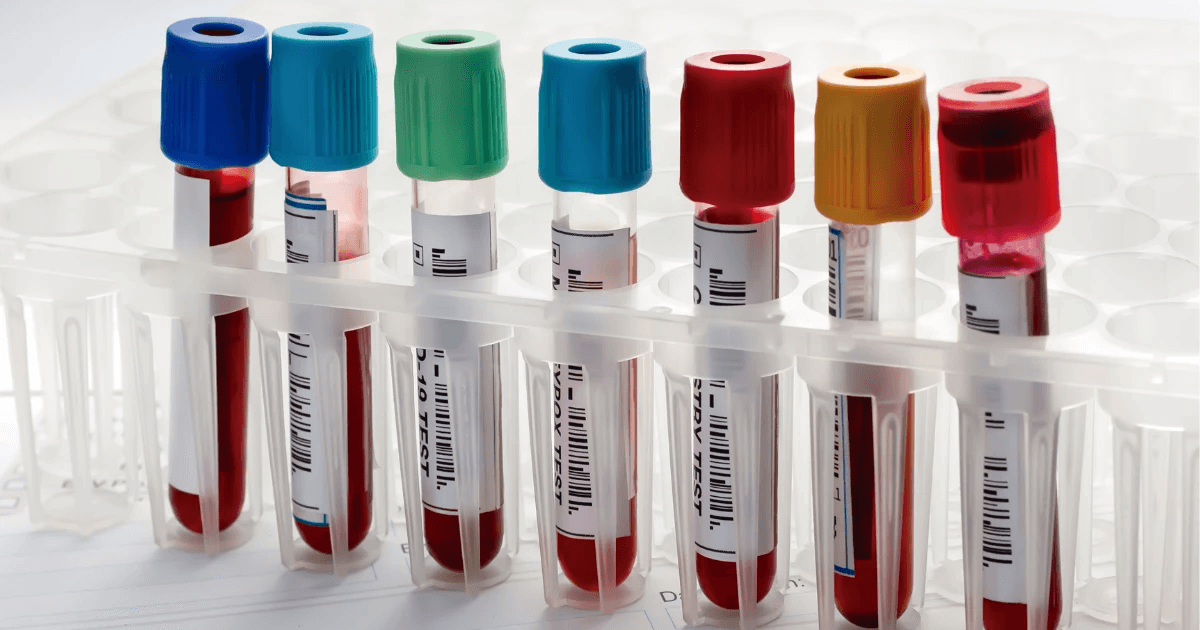
Wrong Blood in Tube (WBIT): The Pre-Analytical Blind Spot in Sample Identification
Roughly one in every 2,000 blood samples sent for blood grouping contains another patient’s blood, and nothing about it looks wrong: the label is correct, the tube is intact and the result is plausible. Large international studies show these wrong blood in tube (WBIT) errors break the assumption every laboratory result rests on: that the blood in the tube belongs to the patient named on the label. Because the sample itself gives nothing away, what happened at the bedside, such as which patient the blood was actually drawn from and whose label went on the tube, remains largely invisible to the laboratory. Most errors are only caught when a result happens to conflict with an earlier one. This guide explains what WBIT is, why it happens, which tests can and cannot reveal it, what it costs and how laboratories can stop it at the point of collection.
What is Wrong Blood in Tube (WBIT)?
A wrong blood in tube error is a sample whose contents do not belong to the patient named on its label. It can happen in two ways. Blood is drawn from the wrong patient and labelled with the intended patient’s details, or blood is drawn from the right patient and labelled with someone else’s. An international case series of 331 WBIT errors by the Biomedical Excellence for Safer Transfusion (BEST) Collaborative found the two almost equally common.
WBIT differs from other labelling problems because the label itself looks right. A mislabelled sample is missing information or doesn’t match its request form, so it fails the laboratory’s acceptance checks and is rejected. A WBIT sample has a complete, consistent label. It just belongs to the wrong person.
| Mislabelled sample | Wrong blood in tube (WBIT) | |
|---|---|---|
| The error | Label is missing, incomplete or doesn’t match the request | Label is complete, but the blood belongs to a different patient |
| Visibility at reception | Visible: it fails labelling acceptance criteria | Invisible: it passes every labelling check |
| Lab response | Rejects it and asks for a new sample | Can only act if a result conflicts with an earlier one |
| Main risk | Delay and a repeat blood draw | A result filed under the wrong patient |
The two problems are closely linked. When transfusion laboratories blood-typed samples they had already rejected for minor labelling errors, a striking number turned out to contain another patient’s blood. A careless label is often the visible sign that patient identification at the bedside also went wrong.
1 in 71 samples rejected for minor labelling errors actually contained another patient’s blood.
Source: Kaufman et al., Transfusion, 2019.
What Causes WBIT Errors?
WBIT errors almost always begin at the bedside, during collection and labelling, before the sample enters any tracked process. They are rarely a single mistake. In the BEST case series, most errors combined a shortcut in protocol with a momentary slip, which is exactly the kind of error that becomes more likely on a busy ward.
- 1Another patient’s labels or tubes within reachThis was the most common contributing factor, present in around six in ten cases. Pre-printed labels, batched draws and shared trays make it easy to put the right label on the wrong tube, and pre-barcoded tubes are just as easy to link to the wrong patient.
- 2Labelling away from the patientTubes labelled at the nurses’ station, or after blood has been drawn from several patients, are no longer physically linked to the person they came from.
- 3Skipped identity checksExamples include not asking the patient to state their name and date of birth, or not checking the wristband against the request. Shortcuts like these were the factor most likely to lead to the wrong patient being drawn.
- 4Workarounds of electronic identificationWhere barcode scanning was available, it was sometimes bypassed or used incorrectly. That removes the very safeguard it was introduced to provide.
These are human-factors failures, not knowledge gaps. The people collecting samples usually know the procedure. Errors happen when time pressure, interruptions and a crowded workspace line up, which is why more training on its own rarely moves the rate.
Which Tests Reveal WBIT?
Every test is affected by WBIT, but only a handful can reveal it. Most WBIT research comes from blood transfusion, and not because transfusion samples are mislabelled more often. Blood grouping is one of the few tests where a wrong patient produces an impossible result: a blood group that doesn’t match the one on file. For almost every other test, a wrong-patient sample simply produces a plausible number. Lippi and colleagues estimate that misidentification affects around 1% of general laboratory specimens, and most of those errors are never flagged.
| Test category | Can the lab detect a WBIT? | Why |
|---|---|---|
| ABO/RhD grouping | Often, if a historical group exists | A blood group never changes, so a mismatch proves a WBIT. Wrong-patient samples with the same blood group stay hidden. |
| Haematology indices (e.g. MCV) | Sometimes | MCV is fairly stable within one patient, so a large jump is a useful warning sign. |
| Routine chemistry (e.g. potassium, glucose) | Rarely | Values change quickly within a patient, so comparing against earlier results catches few errors. |
| First-time patients, any test | No | There is no earlier result to compare against. |
The patients most at risk are those with no previous results, those who cannot confirm their own identity (such as unconscious or confused patients) and those whose samples are collected during busy, batched rounds. The stakes are highest in transfusion, where a WBIT can lead to a patient receiving incompatible blood.
Detection vs. Prevention
WBIT errors are created at the bedside but caught, when they are caught at all, in the laboratory, after analysis has already run. In the BEST case series, more than half were found through pretransfusion testing. Every detection method in use today depends on having an earlier result to compare against:
- Historical blood group comparison works only for repeat patients. It misses wrong-patient draws where both patients share a blood group.
- A group-check sample, often called the two-sample rule, is a second sample taken at a separate blood draw and grouped to confirm the first. UK guidelines recommend one before transfusing a patient with no blood group on record, unless secure electronic patient identification is in place.
- Delta checks flag results that differ sharply from a patient’s previous values. For most single analytes, though, they catch very few errors.
- Clinical implausibility relies on a clinician happening to notice that a result does not fit the patient.
All four act after the sample has left the patient. Once a WBIT is found, the sample is rejected and recollected: the patient needs another venepuncture, and the result is delayed by a full collection-to-result cycle.
The place to stop WBIT is the few minutes at the bedside between identifying the patient and labelling the tube. That is exactly the part of the journey the laboratory has no data on.
The True Cost of WBIT
The cost of a WBIT depends on whether it is caught. A caught WBIT costs a recollection. One that slips through can cost a misdiagnosis, the wrong treatment or, in transfusion, a fatal reaction.
- Patient safety. Misidentification is among the most serious laboratory errors because the result looks completely valid, so nobody questions it. It can lead to misdiagnosis and the wrong treatment, and in transfusion, to a patient receiving incompatible blood.
- Two patients affected, not one. Every WBIT puts the wrong result in one patient’s record and leaves the other patient untested, or carrying someone else’s values.
- Recollection and delay. A detected WBIT means a second venepuncture, a delayed result and the loss of the original collection time.
- Errors nobody sees. Published WBIT rates only count the errors that were detected. When researchers adjusted for the ones that could not be seen, such as wrong-patient draws between two people with the same blood group, the estimated rate more than tripled.
Up to 20% of all mistransfusions are traced to patient misidentification or labelling errors that happen before the sample reaches the laboratory.
Source: College of American Pathologists Q-Probes study of 122 laboratories (Grimm et al., 2010).
The problem does not fade on its own. Researchers from the UK’s national haemovigilance scheme note that the human error rate in transfusion has barely moved despite repeated rounds of education, training, competency testing and guidelines. As long as the bedside stays unmonitored, the cost keeps recurring.
How to Prevent WBIT Errors
WBIT is prevented by closing the gap between identifying the patient and labelling the tube, and by keeping a verifiable link between the two for the rest of the sample’s journey. Technology helps. A BEST Collaborative study across 20 hospitals and more than two million samples found that sites using electronic patient identification at collection had about five times fewer WBIT errors than sites relying on manual checks. The principle is simple: scanning the patient’s wristband and the tube’s barcode together at the bedside turns the link between them into something a system can verify, whether the tube carries a printed label or a pre-applied barcode.
Technology only works alongside good practice. The checklist below follows the three phases of the pre-analytical workflow.
Phase 1: Collection- 1Positively identify the patient before every draw. Ask them to state their full name and date of birth, and check both against the wristband and the request.
- 2Use at least two independent identifiers on every sample.
- 3Bring only one patient’s request, labels and tubes to the bedside at a time.
- 4Where electronic identification is available, scan the wristband at the bedside every time, with no workarounds.
- 5Label each tube at the bedside, in the patient’s presence, immediately after the draw. Never label in advance or in batches.
- 6Record who collected the sample and when, so that any later discrepancy can be traced to a specific event.
- 7For transfusion patients with no blood group on record, take the group-check sample at a separate blood draw, never at the same time as the first sample.
- 8Reject samples that fail labelling criteria, even for minor errors. A careless label is often the visible sign of a WBIT that can’t be seen.
- 9Check each sample at receipt against an expected-sample record, so that missing, extra or unexpected samples are flagged rather than silently accepted.
- 10Track WBIT and mislabelling rates as quality indicators, and review every detected WBIT as a near miss.
The Pre-Analytical Blind Spot
Training and SOPs matter, but on their own they cannot eliminate WBIT, because they leave no record the laboratory can check. Since Plebani and colleagues’ early work, research has consistently traced up to 70% of laboratory errors to the pre-analytical phase. Identification is where those errors are hardest to see. The reason is structural. Everything that decides whether a tube holds the right patient’s blood happens where the laboratory has no data.
With a procedure-only approach:
- There are no timestamps. The laboratory cannot see when, where or by whom a sample was collected and labelled, or whether labelling happened at the bedside or an hour later at the desk.
- There are no real-time alerts. Nothing flags a label printed for one patient being attached at another patient’s bedside, or a tube collected without an identification step.
- Deviations are found only after the fact. Detection depends on a historical blood group, a second sample or a delta check, all of which act after the analysis has run. A first-time patient’s WBIT, or one between patients with the same blood group, is never found.
This is the same blind spot behind other pre-analytical failures, from incorrect patient identification to samples that get delayed or lost in transport. The broader issue is covered in our guide to sample identification in the pre-analytical phase.
The structural answer is end-to-end visibility of each sample’s pre-analytical journey. That means a time-stamped, verifiable record linking patient identification, collection, labelling, transport and receipt, so that a broken link is flagged as it happens rather than discovered afterwards. The evidence points the same way. Researchers reviewing WBIT for the UK’s haemovigilance scheme identified end-to-end electronic systems as probably the most effective intervention. When identification is recorded rather than assumed, WBIT moves from undetectable to preventable.
With S4DX, your laboratory can see this record for every sample. A single barcode scan at collection links the patient, sample and order, and each step is timestamped through to lab arrival.
When every tube can be traced back to the right patient, every result can be trusted.
Key Takeaways
- WBIT means the blood in a tube belongs to a different patient from the one on its label. It happens in about 1 in every 2,000 samples sent for blood grouping.
- Unlike a mislabelled sample, a WBIT passes every labelling check, although careless labelling is often a warning sign of one.
- Most WBIT errors combine a protocol shortcut with a slip at the bedside. Another patient’s labels or tubes within reach is the most common factor.
- Only a few tests can reveal a WBIT, and samples from first-time patients can’t be checked at all.
- Every current detection method works after analysis, while the error happens at the bedside.
- An undetected WBIT can mean misdiagnosis, the wrong treatment or a fatal transfusion reaction, and published rates understate the problem.
- Prevention means positive identification, single-patient bedside labelling, rejecting mislabelled samples and tracking WBIT across collection, handling and transport.
- Training and SOPs leave no timestamps, give no real-time alerts and reveal deviations only after the fact. End-to-end pre-analytical visibility closes that gap.
Frequently Asked Questions
S4DX provides real-time visibility across the full pre-analytical workflow, from collection to laboratory receipt.
Contact us